|
|
|
|
|
Disinfluencers Never Let A Crisis Go To Waste, Hormuz Strait Edition |
|
|
|
Hey, remember when Russia invaded Ukraine and then spent years pumping out disinformation to defend its fossil fueled war machine? So much so that NATO and Polish military intelligence flagged climate disinformation as part of the playbook. If that’s fuzzy, the Center for Climate and Security has you covered with a report all about Putin’s propaganda, from late last year.
Which is to say… Hi again, CAADies! It’s been a minute since our last Data Monitor, but we’re back this month with a familiar reminder: when fossil fuel price shocks hit, the noise ramps up too… especially the false claim that more fossil fuels are the solution to fossil fuel price volatility (spoiler: they’re not). Renewable energy remains the more stable path to energy independence and security from geopolitical instability.
Documented propaganda efforts when invading Ukraine sent prices up - but that was then and this is deja vu all over again… (Or… is it?)
|
|
|
|
Strait Talk: Fossilized Fossil Lies |
|
|
|
For our glorious return to your inbox, CAAD took a look at how climate deniers and ffossil fuel backed narratives and talking points have been responding to rising fossil fuel prices. The pattern is familiar: blame local climate activists, clean energy and/or net-zero policies, and call for more of the problem-causing dirty energy to be built domestically - as if global markets don't exist, which is precisely why prices are rising in the first place.
Some narratives were so predictable - dare we say fossilised - that they barely warrant covering. Particularly across parts of the anglosphere, where partisans in the US who support the war, are downplaying the rising costs as temporary and an acceptable cost for 🇺🇲FREEDOM and 🇻🇮 SECURITY while blaming climate activists and policies that have reduced dependence on fossil fuels for apparently causing these price shocks. Similarly, anti-climate groups in the UK were calling for increased fossil fuel production, especially in the North Sea, as they’ve been doing for ages.
In Canada, DeSmog reported on how the fossil fuel industry’s defenders are living up to the old Machiavellian axiom to “never let a good crisis go to waste,” and are illustrating Naomi Klein’s ‘Shock Doctrine’ in action, where oil-related interests exploit crises like armed conflict to catalyze ever more extraction.”
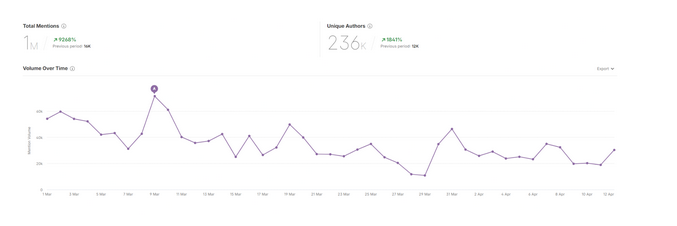
Where things get more interesting is in the data. Our analysis of over 1 million mentions across 236,000 authors, then (narrowed down to 45,000 disinfo related posts) across just 24,000 actors, shows how narratives vary across Spanish speaking countries:
|
 |
|
Figure 1: Spanish-language mentioons of fossil fuels accompanied by mentions of the Iran crisis between 1 March and 12 April 2026. Source: Brandwatch |
|
Keywords for the initial search: (Ormuz or "estrecho de Ormuz" OR "golfo pérsico" OR "Irán") AND (petróleo OR "combustibles fósiles" OR renovables OR "energia verde" OR "energia limpia" OR "transición energética" OR solar OR eólica OR "autos eléctricos" OR "agenda 2030"). |
-
Spain: Primarily political attacks on climate policy following predictable patterns of partisan hostility
-
Argentina: Strongman-style culture war framing glorifying the violence as worth the increased costs and additional problems.
-
Venezuela: Discussions centered on oil sovereignty, which makes sense.
-
Mexico: Familiar claims that domestic production can shield against global volatility - overlooking how global pricing actually works. . .
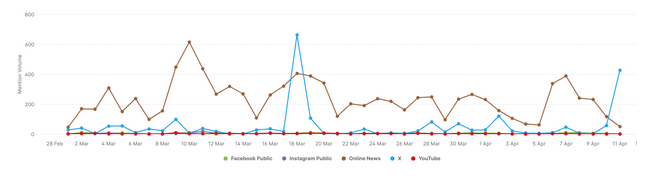
In Portuguese language conversations, Brazilian accounts were louder than those in Portugal. A truck drivers’ strike over high fossil fuel prices became a launchpad for claims that the country’s energy transition was to blame - despite the fact that reducing fossil fuel reliance would lessen exactly this kind of vulnerability. That narrative alone generated over 12,000 mentions reaching an estimated 11.6 million accounts. |
 |
|
Figure 2: Mentions of anti-energy transition narratives between 1 March and 12 April 2026. Source: Brandwatch |
|
Keywords used: "transição energética" OR "agenda 2023" OR "emissões" OR "segurança energética" OR "agenda verde" OR "agenda ESG" OR " agenda 2030" OR "agenda climaticá" |
|
|
|
|
|
War, Disinfo, & Climate: Same Playbook, Higher Stakes |
|
|
|
A new piece from CAAD member FALA, in their Observatory for Information Integrity (Oii), goes on to connect the dots between conflict and climate disinfo, arguing that wartime is not just fertile ground for falsehoods, it is when they become strategic.
As geopolitical tensions rise, so does the incentive for state and industry actors to shape narratives around energy, security, and climate policy. The result is familiar fossil fueled talking points, now supercharged by conflict and aimed at weakening support for the transition.
In other words, it is not just deja vu, it is escalation.
|
|
|
|
|
|
What do we do about it? Same thing we do every day: reframe with a truth sandwich!
Fact: Clean energy is cheap and prices stable, so countries like Spain that have built out wind and solar are faring better as fossil fuel costs rise.
Myth: But, some bad actors or biased outlets, including those you might not expect, are downplaying the reliability of renewables and promoting fossil fuels.
Fallacy: Because fossil fuels are a global commodity, it doesn’t matter what a country’s domestic production is when there are constrictions on the market, so anyone arguing for more fossil fuels is often aligned with vested interests, not because they have your wallet’s best interests in mind.
Fact: As long as we’re addicted to fossil fuels, we’re going to pay whatever price the global market dictates. But because no one can control the sun or wind, renewable energy not only is cheaper and cleaner, but it’s also more reliable in times of turmoil.
|
|
|
|
|
|
|
|
Got a lead that isn’t getting the scrutiny it deserves? Or a hunch that something doesn’t quite add up? Send it our way at contact@caad.info |
|
|
|
|
|
|
|
You are receiving this email having previously subscribed to outputs from our coalition, including the CAAD Data Monitor and COP Intelligence Unit. If you do not wish to receive these emails, click here to unsubscribe | Sent to: _t.e.s.t_@example.com
CAAD, Rue aux Laines, 70, 1000 Brussels, Belgium |
|
|